Folder: /mnt/datapool/hermes_workspace/projects/wind-sculpture-design ·
scaffolded
Start a session here (paste into a terminal):
cd /mnt/datapool/hermes_workspace/projects/wind-sculpture-design && hermesdocs/
concepts.md · log.md · references.md · rendering.md · slow-bloom-bom.json · slow-bloom-structural-brief.md · slow-bloom.md
output/
Drawing-Board-manual.pdf · Slow-Bloom-design-report.pdf · coating-fastener-shortlist.json · markup · references_data.json · renders · slow-bloom-bloom-detail.png · slow-bloom-bom-rollup.json · slow-bloom-elevation.png · slow-bloom-load-inputs.json · slow-bloom-loads-rollup.json · slow-bloom-motion-directions.png · slow-bloom-plan.png · steel_concrete_shortlist_prices.json · uploads
schemas/
drawing_ink_check.schema.json · impression_caption.schema.json · impression_contact_sheet.schema.json · slow_bloom_bom.schema.json · slow_bloom_loads.schema.json · slow_bloom_motion_study.schema.json
app/
MANUAL.md · README.md · __pycache__ · index.html · index.html.bak-20261110-052549 · people.json · people.json.bak-20261108-034737 · server.py
Hermes: this file is the context for the Wind Sculpture Design project assistant.
You are in /mnt/datapool/hermes_workspace/projects/wind-sculpture-design. Work from here unless told otherwise.
Design wind-driven sculpture at yard and garden scale, with the emphasis on concept and form — the art of it — over structural engineering.
impression set finished on 2026-11-08 (NDY-5); the directions of movement and the size of every piece
are stated on all three drawing sheets on 2026-11-08 (NDY-6); the directions of movement were stated on
every image and the motion study was drawn on 2026-11-08 (NDY-7). Mike's five decisions are applied to
the concept sheet and the BOM, the structural-check brief he asked for exists, the accurate drawing set
is three sheets, and there are four captioned impression stills, an impression of the movement, and an
ACCURATE, code-drawn motion study (one sheet + one 8-second clip). Nothing is ordered, nothing is cut,
nothing is welded.**
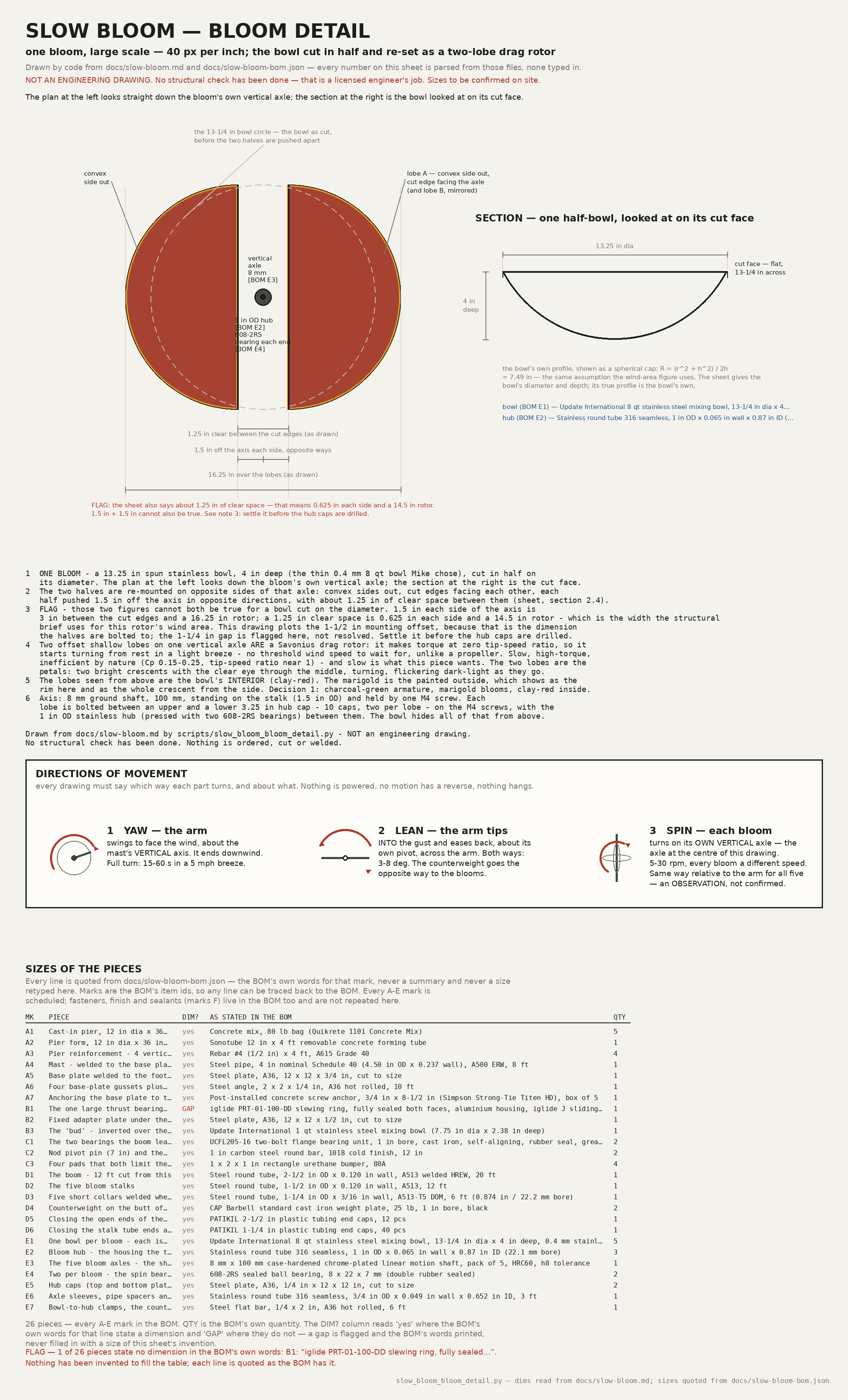
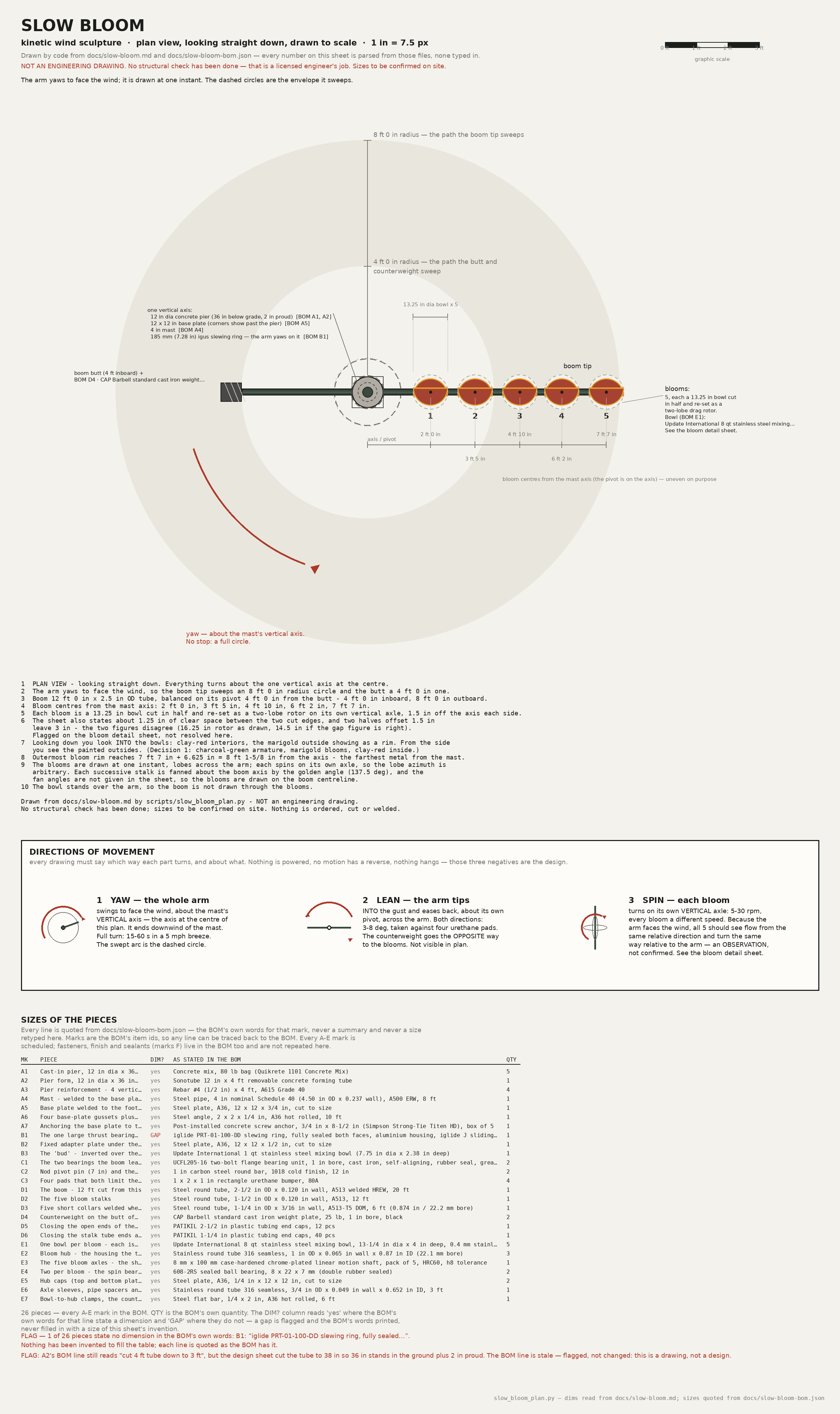
output/slow-bloom-plan.png (plan view: the swept envelope, the five bloom positions, the foot and the
axis, dimensioned) and scripts/slow_bloom_bloom_detail.py -> output/slow-bloom-bloom-detail.png (one
bloom large scale: the two offset lobes on the vertical axle, plus a section on the cut face). Both
parse every number from docs/slow-bloom.md, quote each piece's size from docs/slow-bloom-bom.json by
mark, carry the DIRECTIONS OF MOVEMENT panel and the NOT AN ENGINEERING DRAWING disclaimer required
by docs/rendering.md, and audit their own layout (the render fails if any element lands off the page).
Two flags, recorded not resolved: (1) §2.4/step 7 push each bowl half 1-1/2 in off the axis while
§2.4 also states about 1-1/4 in of clear space between the cut edges — 1-1/2 + 1-1/2 cannot also be
true (16-1/4 in rotor as drawn vs the 14-1/2 in the structural brief's wind area); the drawings plot
the 1-1/2 in mounting offset and print the conflict on the sheet face; (2) the BOM's A2 line still
reads "cut 4 ft tube down to 3 ft" against the sheet's 38 in — stale, printed on the plan sheet. The
design sheet and the BOM were NOT edited: drawing, not designing.
(hero three-quarter / from below looking up / golden-hour backlit / overcast winter) and
output/renders/slow-bloom-motion-study.mp4 (8.04 s, 1280x720, 24 fps, showing yaw, lean and per-bloom
spin), with output/renders/README.md listing every file and recording what came back wrong. **They are
impressions and they say so in their file names and captions — never send one to a buyer or a
fabricator as a depiction of what they are getting; send output/slow-bloom-elevation.png.** 23 stills
were generated and 19 rejected: wrong bloom count 12 times, blooms drawn as whole unsplit bowls 6
times, blooms hanging below the arm 3 times, too few blooms 3 times, flat-poster look 3 times (the
poster failures were self-inflicted — complexity:-80/-90, an error of mine, not the model's). All
four finals were counted with vision_analyze at full resolution: one post, one arm, five blooms, every
bloom split into two offset crescents. New tool pair
scripts/impression_contact_sheet.py + schemas/impression_contact_sheet.schema.json (tiles
candidates into one labelled sheet so a single look covers several panels — the vision model is
rate-limited). The video needed a child Hermes process because the video_gen toolset is disabled for
the cli platform in ~/.hermes/config.yaml; image_gen is enabled and the stills were made in-session.
Rendering changed nothing: no design, BOM or price was touched.
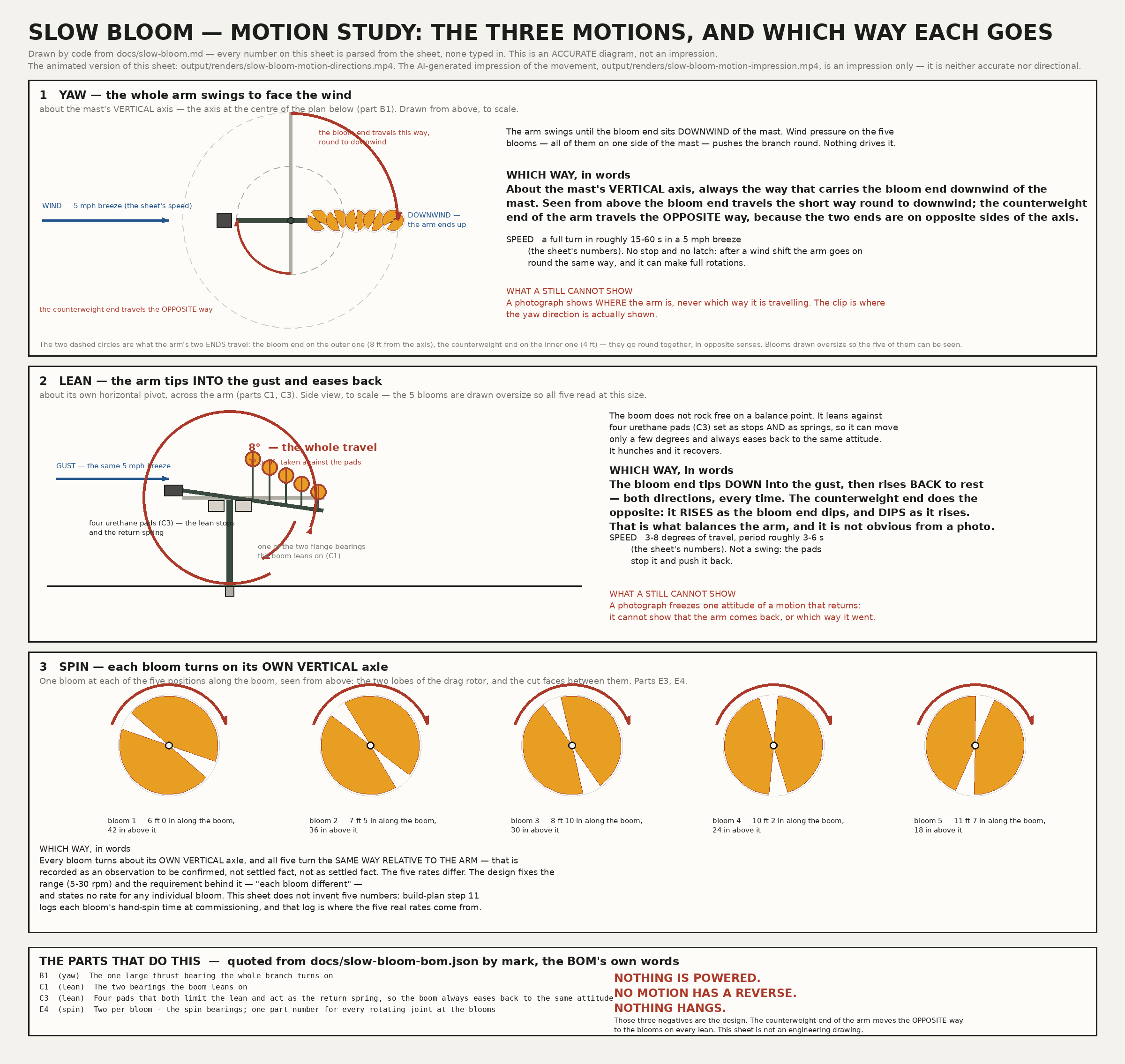
scripts/slow_bloom_motion_study.py + schemas/slow_bloom_motion_study.schema.json draws
output/slow-bloom-motion-directions.png (the three motions, a curved arrow on the axis each turns
about, both lean directions, the swept sector for the yaw, the parts quoted from the BOM by mark) and
output/renders/slow-bloom-motion-directions.mp4 (8.00 s, 1280x720, 24 fps, one motion at a time, the
three labels in every frame's footer). Both audit their own layout every frame and refuse to write if
an element lands off the page. New tool pair **scripts/impression_caption.py +
schemas/impression_caption.schema.json** burns the kind, the frame's motion and all three directions
onto each impression as a band BELOW the photograph; the uncaptioned originals are kept in
output/renders/uncaptioned/. The AI video could not state a direction (sampled frame by frame: the
arm is level in every frame, no per-bloom rate legible), so it was renamed
output/renders/slow-bloom-motion-impression.mp4 and the code-drawn clip carries the name motion study.
output/renders/README.md rewritten: per-still motion state, the three labels with directions in words,
the counterweight moving the opposite way, and the three negatives. Honest limits recorded: the clip is
sped up and invents no per-bloom rpm (the sheet fixes the range and "no two alike", not five numbers —
build step 11 logs the real ones). Also fixed a real bug in scripts/impression_contact_sheet.py (the
--images flag swallowed the following flags' values). Rendering changed nothing: no design, BOM or price.
Re-opened and reviewed, then fixed, on 2026-11-08 (NDY-7 follow-up): the clip's header printed its
attribution line through the last two words of the title in every frame (1778 px² of letters on letters,
invisible to the off-page audit). Both renders now carry the text-overlap gate the drawing sheets got in
NDY-6 — proved to fire — and the clip was re-rendered (sha256 5e757762…; the still sheet was untouched,
hash unchanged). The four stills' captions and the sheet were re-read and are clean.
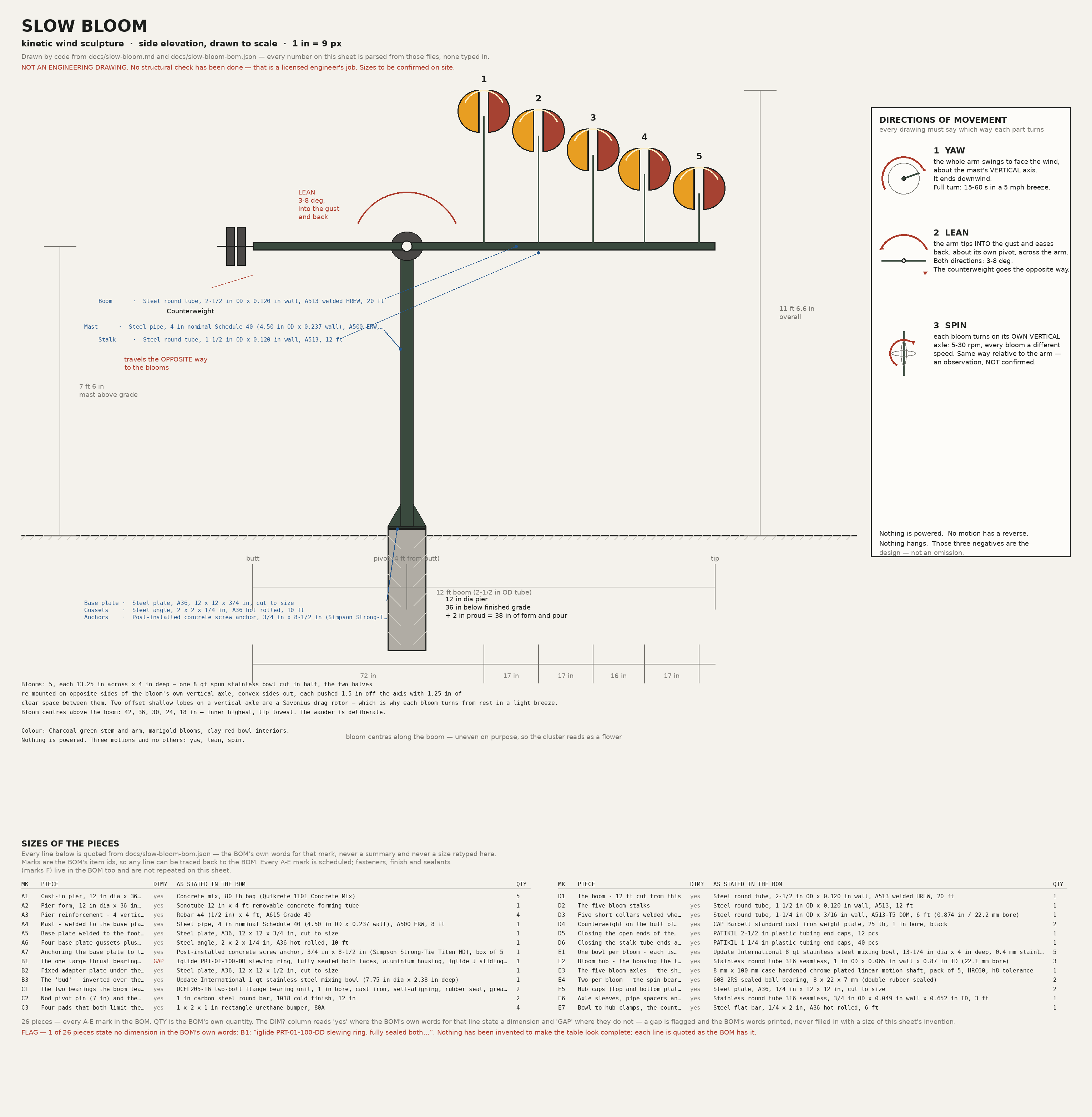
drawing sheets. Each sheet now schedules every A-E mark in the BOM — 26 pieces — read from the BOM
rather than typed into the script, quotes the BOM's own words by mark, and carries a DIM? column**:
yes where the BOM states a dimension, a red GAP where it does not, plus a red line under the table
naming the gap marks. One gap, and it is flagged, not filled: B1 (the igus slewing ring) is the only
line whose text states no size — the 185 mm ring figure lives in that line's notes, so the sheet prints
the line and flags the cell. The elevation's hand-typed piece callouts became BOM lookups by mark (A4,
A5, A6, A7, D1, D2, plus D4/E1 on the plan and E1/E2 on the detail).
Four gates now guard every sheet, and each was proved to fire (negative-tested): off-page box audit
(now a hard fail in the elevation too, not just a printed warning), require() presence — fails when a
named element was never drawn at all, the one failure a box audit cannot see — text-overlap (pairwise
text boxes, fails above 240 px²) and size-table column fit (laid out from the measured font advance
width). New tool pair scripts/drawing_ink_check.py + schemas/drawing_ink_check.schema.json: a
region-of-ink check on a finished PNG — named bands in, ink fraction and a BLANK verdict out, exit 1 on a
blank band; all three sheets report 0 blank bands.
A real bug found and fixed, and vision_analyze was wrong about it: the elevation drew its motion
headings with a centred vertical anchor, so 1 YAW printed straight through its own paragraph on every
elevation ever produced. PIL's own ink rows proved it (title rows 143-159 sitting inside the body's
136-225, same x-range) after vision_analyze twice reported the heading "on its own line, clearly
separated" and read the mangled paragraph back coherently. The heading is now top-anchored like the other
two sheets. Also fixed real collisions: the elevation's base-plate callout and notes band against the
dimension labels, the detail's two dimension labels overlapping by 14 px, and the plan's A2-stale flag
printing over the footer. Drawing, not designing: docs/slow-bloom.md and the BOM are untouched, and the
NDY-4 flags (bloom geometry, the stale A2 line) still stand as flags.
shortlist, cut-list-level build plan, the bearing/Calder risk treatment), docs/references.md,
docs/slow-bloom-bom.json checked by scripts/slow_bloom_bom.py + schemas/slow_bloom_bom.schema.json.
docs/slow-bloom-bom.json. BOM is now 36 lines, all primary, $2,396.48 — a saving of $436.00
against $2,832.48, validating clean (30 page / 5 listing / 1 quote). F1 (epoxy primer) and
F2 (marine LPU) were deleted and F3 promoted from alternate to primary; line ids were deliberately
NOT renumbered. Decision 5 delivered as docs/slow-bloom-structural-brief.md, whose numbers come
from output/slow-bloom-load-inputs.json run through the new tool pair
scripts/slow_bloom_loads.py + schemas/slow_bloom_loads.schema.json.
1. Colours: charcoal-green stem, marigold blooms, clay-red interiors (pairing 1 — the warm
one; strongest flicker, reads from the street).
2. Main pivot ring: the fully sealed ring, not the standard one. The quoted price and the
25–30 working day lead time are accepted — treat that lead time as a real constraint on
the build schedule.
3. Finish: the single-can direct-to-metal enamel at $53.98, NOT the marine two-part LPU.
Drops roughly $435 from the bill. State the consequences honestly rather than glossing them:
shorter service life than the boat system, and because it is direct-to-metal the primer line
no longer applies.
4. Blooms: the thin 0.4 mm bowl at $17.29 each — motion over toughness. They will dent;
they are cheap to replace, which is the trade Mike accepted.
5. Structural check: YES, before any metal is cut. Do not perform structural
engineering — prepare the package a licensed structural engineer needs (geometry as built,
the ~90 lb moving load and how it is applied, the county's 115 mph design wind, foundation
assumptions, and the specific questions to ask). Say plainly that the check itself is a
professional's job.
1. The sealed ring's actual price. igus publishes none; the bill carries a $398.83 floor
allowance (the standard ring's published price) and states the total both ways. If the ring
lands at the 80 mm-implied sealed premium (~$1,050) the bill becomes $3,047.88 — i.e. the
finish saving is more than cancelled by the ring. That is the honest headline.
2. Coating colour. Decision 1 wants three colours; decision 3 bought a finish that cannot be
tinted (Rust-Oleum Professional is a fixed palette and flat is stocked only in black/white).
§2.5 sets out three ways out. This is the one place where two of Mike's own decisions pull
against each other, so it is named rather than quietly resolved.
3. The structural check itself — a licensed engineer's job. Awaits Mike taking the brief to one.
4. The bloom geometry (NDY-4). §2.4 and build step 7 push each bowl half 1-1/2 in off the axis;
§2.4 also says about 1-1/4 in of clear space between the cut edges. Both cannot be true — 1-1/2 in
each side leaves 3 in and a 16-1/4 in rotor, while a 1-1/4 in gap means 5/8 in each side and the
14-1/2 in rotor the structural brief's wind-area figure uses. The drawings plot the 1-1/2 in
mounting offset and print the conflict on the sheet face. Settle it before the hub caps are drilled.
5. The BOM's A2 line (NDY-4). It still reads "cut 4 ft tube down to 3 ft" while the sheet cut the
tube to 38 in. Stale text, printed on the plan sheet's schedule, flagged and not changed.
6. The five real spin rates (NDY-7). The design fixes the range (5-30 rpm) and requires that no two
blooms run alike, but states no rate for any individual bloom. The motion study therefore shows
relative rates and says so; the real five come from build-plan step 11, which logs each bloom's
hand-spin time at commissioning. Nothing to settle now — just do not quote the clip's x-rates as
design numbers.
mass (the sheet said ~90 lb; itemised it is 156.5 lb, of which 50 lb is counterweight) and the
pier depth (a 3 ft form tube struck 2 in proud left only 34 in in the ground — 2 in short of the
36 in adopted frost depth; the tube is now cut to 38 in).
engineer.** In parallel: settle the coating colour, settle the bloom geometry (open item 4), fix or
confirm the BOM's A2 line (open item 5), and get igus to quote the sealed ring. After the check comes
back: the igus PRT configurator run for service life, then fabrication drawings. **The accurate
drawing set is complete** — three sheets, one script each: elevation, plan view, bloom detail.
The impression set (NDY-5) is delivered and needs nothing further from this assistant: it is mood and
marketing only, and none of it will change when the engineer's answer arrives. So is the motion study
(NDY-7): one sheet and one clip, both drawn by code from the design sheet, plus every image captioned
with the three directions. The one thing that will date it is the spin rates — the five real ones come
from build step 11 at commissioning, and the clip says so.
Nothing is ordered, cut or welded until the structural check comes back.
One fully documented concept for a yard-scale piece: reference sheet, the form described or sketched, a materials shortlist, and a build plan detailed enough to start cutting.
```
/mnt/datapool/hermes_workspace/projects/wind-sculpture-design/
.hermes.md this file — auto-loaded project rules
README.md human quickstart (how to start THIS assistant)
src/ source code for the project
scripts/ runnable one-off scripts + generated tools
schemas/ JSON schemas for every custom tool (<name>.schema.json)
output/ generated artifacts, reports, exports
docs/ notes, decisions, references
venv/ per-project Python venv (created on demand)
```
Shared, project-independent facts (host, storage, runtime) live in
/mnt/datapool/hermes_workspace/ENVIRONMENT.md — read it instead of assuming.
1. Save every generated script, schema, and output under /mnt/datapool/hermes_workspace/projects/wind-sculpture-design/ —
never leave artifacts in ~ or the scratch dir.
2. Every custom tool ships as two files in the same change:
scripts/<tool_name>.py and schemas/<tool_name>.schema.json.
Copy the working pair at /mnt/datapool/hermes_workspace/templates/example_tool.py +
example_tool.schema.json as the starting shape: pure function, stdin JSON →
stdout JSON, no side effects on import.
3. Test before marking anything complete. No Docker here: use
/usr/bin/python3 -m venv venv && ./venv/bin/pip install ... (bare python3
in a Hermes session is Hermes' own runtime and has no pip), or run the script
and show real output. Paste actual command output, never a description of it.
4. Keep terminal explanations to a single copy-and-pasteable command per step.
5. Put reference images and notes under this project docs/ and output/ — never in the home directory.
6. Commit as this worker, not as Mike. Git authorship is part of the audit trail, and commits
written under Mike's name read as if he wrote them. Always:
git -c user.name='Wind Sculptor' -c user.email='wind-sculptor@3050' commit -m "...".
Never rely on the repository default identity.
7. Python venvs cannot be created on the SMB share — /mnt/datapool is CIFS and refuses the
lib64 symlink (Errno 95, Operation not supported), with or without --copies. Build venvs on
local disk instead (e.g. /home/mike/.venvs/pdf) and call them by absolute path.
Hermes + delegate_task subagents; web search for precedent and reference; image generation for concept renders (confirm it is configured before relying on it).
docs/references.md, concept sheets, concept render images, materials shortlist
This block is injected into every project's .hermes.md by bin/new-project, so
host facts live in ONE place. Update here, not per project.
mike//10.0.0.5/datapool mounted at /mnt/datapool (cifs, vers=3.1.1, uid/gid 1000, rw). There is NO /mnt/t130_storage on this host.
/mnt/datapool/hermes_workspace//usr/bin/python3 (3.14.4, venv + pip both work). ⚠ Inside a Hermes session, bare python3 resolves to Hermes' own bundled runtime
(3.14.7) which has no pip — python3 -m pip install x fails with
"No module named pip". Always build project venvs explicitly:
/usr/bin/python3 -m venv venv && ./venv/bin/pip install ...
huggingface_hub 2.4.0, mcp 2.3.0, numpy 2.5.4 (cp314 wheel) and tokenizers 0.23.3 all resolve — the HF/MCP stack is fine
on this Python, no downgrade needed.
~/.hermes/ (config, skills, cron, sessions, state.db)main). Two local configs are mandatory on the SMB share, not cosmetic: core.filemode=false (the share forces
0755) and core.trustctime=false — CIFS ctimes are unreliable, and with them
trusted git add can treat a just-written file as unchanged and commit a **stale
blob**. Commit when a unit of work is finished:
cd /mnt/datapool/hermes_workspace && git add -A && git commit -m "...", then
confirm git status --short is empty — if it still lists files, re-add and commit
again before trusting the commit.
9616162615e7 mirrors the workspace to gdrive:3050-HOME/hermes_workspace (one-way up, .git included, so the
Drive copy is a real clonable repo). Script ~/.hermes/scripts/backup_hermes_workspace.sh,
log ~/.hermes/cron/output/hermes-workspace-backup.log. It prints nothing on
success and pings Telegram only on failure.
rclone sync against a missing mount would delete the Drive copy, so it gates
on the mount, a sentinel file, and a minimum file count, and caps deletions.
3050-to-Drive bisync job (sync_to_drive.sh, which covers $HOME/{book,hermes-3050,agent-os,projects,bookapp}).
Two sync jobs touching one tree is how you get conflicts.
Verified against live command output 2026-10-30. Re-verify with:
hostname; ip -4 addr; mount | grep datapool; python3 -V; node -v; docker --version
There are two kinds of image and they must never be confused — the full workflow
is in docs/rendering.md. Read it before drawing or generating anything.
(scripts/<design>_elevation.py), so the picture cannot disagree with the design.
A fabricator may work from these. Never hand-type a dimension into a drawing — parse
the sheet, and let the gather step fail loudly if the sheet changes shape.
image_generate, provider nous). Mood andmarketing only. They will get the geometry wrong: the first Slow Bloom
impression came back with two arms, six blooms and unsplit petals. Never send one to
a customer or a fabricator as a depiction of what they are buying.
file name and caption if it is an impression.
vision_analyze for clippedtext, overlapping text, and element counts. A zero exit code proves nothing about a
picture.
output/ (drawings) and output/renders/ (impressions and video). (scripts/slow_bloom_motion_study.py -> output/slow-bloom-motion-directions.png and
output/renders/slow-bloom-motion-directions.mp4); a GENERATED impression of the movement is
<design>-motion-impression.mp4. A generated video cannot state a direction — the Slow Bloom
impression was level in every sampled frame — so the direction of each motion is drawn by code, and a
sped-up clip says on its face that it is sped up.
burned onto the picture (scripts/impression_caption.py, band appended below the photograph, original
kept in output/renders/uncaptioned/), and a caption that cannot state a direction is not finished.
Mike marks drawings up himself at the drawing board (the web app in app/,
port 8082 — see app/README.md). Every save lands in output/markup/ as a pair:
<drawing>-markup-<stamp>.png — the drawing with his marks burned on<drawing>-markup-<stamp>.json — the same marks as data, in image coordinates,plus the "Changes I want" notes he typed
**Before you redraw or revise any drawing, read the newest output/markup/*.json
for that drawing.** His typed notes are the work order; the drawn marks show what
they point at. Two rules:
drawing was displayed. Convert from those, not from anything on his screen.
rather than silently picking one — the sheet is the design, and his note may be
the newer intent or may be a misunderstanding of what is already there.
When work stops: update Status (state + next step) in this file, then log one
line in /mnt/datapool/hermes_workspace/projects/wind-sculpture-design/docs/log.md with date + what changed + what's next.
Built live from your own files — nothing here is typed by hand.